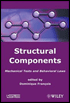
Structural Components: Mechanical Tests and Behavioral Laws
Chapter 7: Impact Tests

7.1 Introduction

Knowing the mechanical characteristics deduced from tensile tests may be insufficient since fractures can take place below the yield strength in conditions such that the material is brittle. A common factor of these conditions is stress concentration linked to a defect which can vary according to temperature, strain rate and dimensions of loaded parts. One of the most traditional mean to characterize steel brittleness is the impact test [BAR 93].

7.2 Some History [MAN 99, TOT 02]

The oldest known publications concerning impact effect on a material date back to early 19 th century and they are the work of Tredgold who was interested in the dynamic loading resistance of steel. In 1857, Captain Rodman designed an impact testing machine to characterize weapon steel and for 30 years it was used to qualify steels, in particular those for railroads. This first impact device used homogenous rectangular bar test pieces, without any notch or crack. Thus, this test allowed the implementation of results for quite brittle materials, whereas tests on ductile materials could not be interpreted. Le Chatelier introduced notched test pieces in 1892, and he demonstrated that materials which displayed ductile behavior in tests using un-notched test pieces could behave in an extremely brittle manner as soon as a notch was introduced. In 1898, Russel designed a testing machine based on the concept of an impact pendulum very similar to the devices which are used nowadays. Impact tests were frequently investigated at the beginning of the 20

UNLIMITED FREE
ACCESS
TO THE WORLD'S BEST IDEAS

SUBMIT
Already a GlobalSpec user? Log in.

This is embarrasing...

An error occurred while processing the form. Please try again in a few minutes.

Customize Your GlobalSpec Experience

Category: Mechanical Testing Services
Finish!
Privacy Policy

This is embarrasing...

An error occurred while processing the form. Please try again in a few minutes.