Structural Steel Designer's Handbook, 3rd Edition

Use this comprehensive, A-Z guide to find a wealth of practical techniques for cost-effectively designing steel structures, from buildings to bridges.
 TABLE OF CONTENTS
 The basic design procedures that apply to bridges with straight stringers apply also to bridges with curved stringers (Arts. 12.1 to 12.5). In determination of stresses, however, the effects of curvature must be taken into account (Art. 12.6).
To illustrate the design procedure, a curved, two-lane highway bridge with simply supported, composite, plate-girder stringers will be designed. As indicated in the framing plan in Fig. 12.25a, the stringers are concentric and the supports and diaphragms are placed radially. Outer girder G 1 spans 90 ft and has a radius of curvature R 1 of 300 ft. Spacing of diaphragms along this span is d 1 = 15 ft. Distance between inner and outer grids G 1 and G 3 is D = 22 ft c to c, and G 2 is midway between them. The typical cross section in Fig. 12.25b shows a 22-ft-wide roadway flanked by two 3-ft 3-in-wide safety walks.
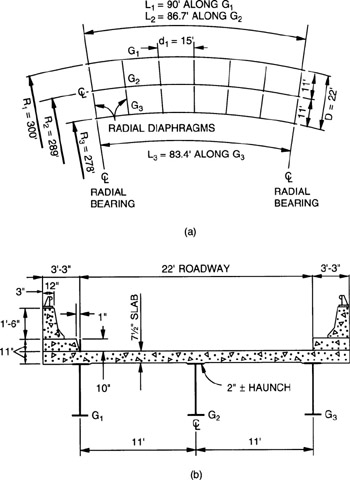
Structural steel to be used is Grade 36. Concrete to be used for the deck is Class A, with 28-day strength f c ? = 3000 psi and allowable compressive stress f c = 1200 psi. Appropriate design criteria given in Sec. 10 will be used for this structure. The approximate analysis described in Art. 12.6 for open framing will be applied to...