The Student's Introduction to MATHEMATICA: A Handbook for Precalculus, Calculus, and Linear Algebra

The Manipulate command is used to manipulate an expression in real time using the mouse (or even a gamepad controller; see Exercise 7). One of the most basic uses of Manipulate is to evaluate a function defined over an interval, say 1 ? x ? 10. In such a case, the syntax is identical to that of the Plot command:
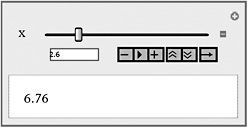
In[1]:= <b class="bold">Manipulate[x</b><sup<b class="bold">2</b></sup><b class="bold">,</b> <b class="bold">{x, 1, 10}]</b><span class="inlinemediaobject"><a NAME="IMG_139"> href="portalcontent.asp?bkid=31099&image_src=https://images.books24x7.com/bookimages/id_31099/fig88%5F01%5F0%2Ejpg&image_id=139&previd=IMG_139"> target="_parent"><img alt="Image from book"> border="0"> height="108"> id="IMG_139"> src="https://images.books24x7.com/bookimages/id_31099/fig88_01.jpg"> title="Click To expand"> width="296"></a></span> The controller, aptly called a manipulator, initially displays as a slider. Clicking on the
button to the right of the slider, however, will reveal additional controls beneath:

Now operate the slider. It ranges over the values from 1 to 10 in this example, and the current value is displayed in the input field directly under the slider. The function value f( x) = x 2 is displayed below. Try it. As you position your mouse over any control button, a tooltip will appear that describes that button s function. For instance, the Play/Pause button
is used to start and stop an animation, while the buttons on either side of it will advance it forward or backward one frame at a time. The double up and down arrow buttons are used to adjust the speed of the animation, and the direction button on the far right is used to determine whether...