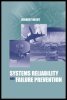
Systems Reliability and Failure Prevention
Chapter 2: Essentials of Reliability Engineering

This chapter summarizes terminology and relationships commonly used in reliability engineering. It can be skimmed by current practitioners and gone over lightly by those who have at least occasional contact with reliability activities and documents. For all others we will try to provide the essentials of the field in as painless a manner as possible.

Stripped of legalese, the reliability of an item can be defined as (1) the ability to render its intended function, or (2) the probability that it will not fail. The aim of reliability engineering under either of these definitions is to prevent failures but only definition (2) requires a statistical interpretation of this effort such as is emphasized in this chapter.

2.1 The Exponential Distribution

In contrast to some later chapters where there is emphasis on causes of failures we are concerned here only with the number of failures, the time interval (or other index of exposure to failure) over which they occurred, and environmental factors that may have affected the outcomes. Also, we consider only two outcomes: success or failure. Initially we assume that there are no wear-out (as in light bulbs) or depletion (as in batteries) processes at work. When all of the stated assumptions are met we are left with failures that occur at random intervals but with a fixed long-term average frequency.

Similar processes are encountered in gambling (e.g., the probability of hitting a specific number in roulette or drawing a specific card out of a deck). These situations were investigated...

UNLIMITED FREE
ACCESS
TO THE WORLD'S BEST IDEAS

SUBMIT
Already a GlobalSpec user? Log in.

This is embarrasing...

An error occurred while processing the form. Please try again in a few minutes.

Customize Your GlobalSpec Experience

Category: Standards and Technical Documents
Finish!
Privacy Policy

This is embarrasing...

An error occurred while processing the form. Please try again in a few minutes.