Systems Reliability and Failure Prevention
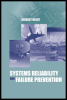
Chapter 7: Software Reliability

Overview

This chapter addresses the reliability of software, frequently referred to as embedded software, that is essential to operate a system. If the software is part of a feedback control system it must respond quickly and is then called real-time software. An example of real-time software is in the flight control system of a high-performance aircraft that must respond within a few milliseconds. An example of nonreal-time embedded software is an intrusion monitoring system that requires a response within a few seconds.

The nature of a software failure is quite different from that of most hardware failures and yet, in the embedded software environment, it is necessary to develop measures of software reliability that can be factored into system reliability. This problem is explored in Section 7.1. The conduct of software tests and the interpretation of software test results also differ significantly from hardware practices. This is discussed in Section 7.2.

Next we will turn our attention to past investigations of software failures to piece together factors that need to be controlled to prevent future ones. Section 7.3 reviews practices for preventing software failures and finds that they are not necessarily aligned with the known causes. In Section 7.4 software fault tolerance techniques are surveyed. Approaches to software reliability modeling are described in Section 7.5, followed by the chapter summary.

UNLIMITED FREE
ACCESS
TO THE WORLD'S BEST IDEAS

SUBMIT
Already a GlobalSpec user? Log in.

This is embarrasing...

An error occurred while processing the form. Please try again in a few minutes.

Customize Your GlobalSpec Experience

Category: Embedded Programming Software
Finish!
Privacy Policy

This is embarrasing...

An error occurred while processing the form. Please try again in a few minutes.