Telecommunications Measurements, Analysis, and Instrumentation
ROBERT EASSON and ROBIN SHARP
Hewlett-Packard Ltd.
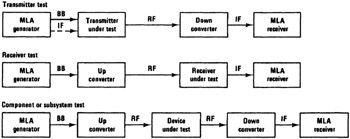
Conventional microwave link analyzer (MLA) measurements using upconverters and downconverters as required to measure distortions in a microwave transmitter or receiver or in a microwave path or subsystem are limited by the test equipment in two major aspects: first, residual distortions (which limit measurement accuracy) and, second, bandwidth (which limits the usefulness of such measurements in waveguide testing and in some wideband satellite systems). In this chapter, the use of a tracking downconverter to overcome both limitations is described, and a number of applications are highlighted.
For the measurement systems shown in Fig. 10.1, the corresponding distribution of residual error contributions from individual test instruments is shown in Table 10.1. Two observations can be made concerning MLA contributions. First, the MLA generator can be omitted, since it is normally used only to generate single baseband tones and a low-frequency (typically 70 Hz) sweep. In the one case where its IF output is used with an IF upconverting transmitter, the MLA generator and receiver IF residual errors can be calibrated out by a separate back-to-back measurement. Second, in microwave path or subsystem testing, the upconverter and downconverter residuals can, in principle, be calibrated out in a similar way. However, practical difficulties such as cable effects frequently introduce further uncertainties in measurement accuracy.
| Test system component | |
|---|---|
| Unit under... |