Telecommunications Measurements, Analysis, and Instrumentation
CATHARINE M.MERIGOLD
Hewlett-Packard Co.
As the performance of radio communications systems improves, the phase-noise requirements of the signal sources often become the limiting factor for the overall system. In this chapter, the first part, on phase-noise basics (Sections 11.1 to 11.5), defines phase noise and its importance in modern communications systems. Then in the second part, on phase-noise measurements (Sections 11.6 to 11.8), the most common methods for phase-noise measurements are described, with a comparison of the methods, their performances, and their applicabilities.
The commonly used term phase noise is really a subset of the broader category of frequency stability. Frequency stability is the degree to which an oscillating source produces the same frequency value throughout a specified period of time [Lance, 11.14]. The stability of a signal source decreases if the signal is anything other than a perfect sine function.
To understand better frequency stability and phase noise, we first gain an intuitive feel. A perfect sinusoidal signal can be represented by
where
V(t)=instantaneous output voltage of the signal
V 0=nominal peak amplitude of the signal
f 0=average (nominal) frequency of the signal
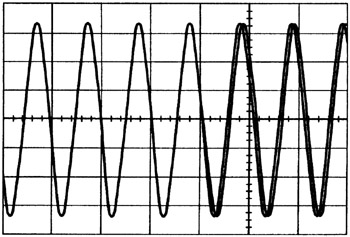
This signal appears in the time domain as a perfect sinusoid (Fig. 11.1) and in the frequency domain as a single spectral line (Fig. 11.2(a)).