Thin-Layer Chromatography: A Modern Practical Approach
3: Cutting TLC/HPTLC Sheets and Plates

3 Cutting TLC/HPTLC Sheets and Plates

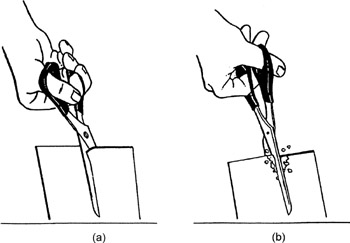
Although TLC plates can easily be cut with a glass cutter, and plastic and aluminium sheets can be cut with a pair of scissors, care does need to taken to avoid damage to the chromatographic layer. A clean pair of rubber or plastic gloves is essential when cutting glass plates to prevent contamination of the layer and any damage to the hands. Cutting aluminium and plastic sheets needs to be done in such a way that the minimum amount of damage to the surrounding layer occurs. A large pair of scissors is preferable with as few scissor cuts as possible. Always angle the scissors at approximately 30 from the vertical to one side as shown in Figure 38.


Figure 38: Cutting aluminium-backed TLC sheets. The angle of cut is important to limit damage to the layer. A correct cut to the left tilted 30 from the vertical is shown in example (a), whereas a cut to the right in example (b) causes a cracking of the layer in the vicinity of the cut

Poor cutting will result in a capillary crack between the chromatographic layer and the foil. This will cause the mobile phase to migrate more rapidly at the edge compared with the centre of the layer, and the mobile phase to migrate from the edge of the layer to the centre. This will cause spots or bands near the edge of the chromatogram to become deformed and chromatographic tracks to...

UNLIMITED FREE
ACCESS
TO THE WORLD'S BEST IDEAS

SUBMIT
Already a GlobalSpec user? Log in.

This is embarrasing...

An error occurred while processing the form. Please try again in a few minutes.

Customize Your GlobalSpec Experience

Category: Laser Cutting and Welding Machines
Finish!
Privacy Policy

This is embarrasing...

An error occurred while processing the form. Please try again in a few minutes.