Thin-Layer Chromatography: A Modern Practical Approach
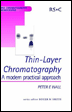
Chapter 7: Quantification and Video Imaging

1 Introduction

The separated analytes on a thin-layer chromatogram can be quantified in a number of ways. An estimate of the concentration can be simply made by applying standards of known concentration alongside the sample at the application stage of the analysis. This is the basis of the pharmacopoeia related substances test where the concentration of the sample impurities is hopefully less than or equal to the standard concentration applied. The results are examined visually in visible and UV light to determine the unknown. The test is limited, and depends on the observer's eye deciding that the concentration is less than that of the standard. The human eye is capable of detecting 1 ?g of a coloured zone on the sorbent layer with a reproducibility of 20-30%.

A more accurate, but tedious procedure involves the elution of the relevant chromatographic zone from the sorbent followed by determination of the concentration in solution by instrumental techniques, such as UV or visible spectro-scopy or for radiolabelled compounds, liquid scintillation counting. The point of a bradawl or a microspatula can be used to scratch out the perimeter around the zone of interest. A microspatula is then used to scrape away the zone within the marked area. The scrapings are transferred to a suitable container holding the extraction solvent. The mixture is agitated to dissolve the analyte and the sorbent removed by centrifugation or filtering. Finally the resulting solution forms the basis of the determination usually by spectrophotometry at a specified wavelength. The...

UNLIMITED FREE
ACCESS
TO THE WORLD'S BEST IDEAS

SUBMIT
Already a GlobalSpec user? Log in.

This is embarrasing...

An error occurred while processing the form. Please try again in a few minutes.

Customize Your GlobalSpec Experience

Category: Solid Phase Extraction Cartridges and Disks
Finish!
Privacy Policy

This is embarrasing...

An error occurred while processing the form. Please try again in a few minutes.