Turbine Steam Path Maintenance and Repair, Volume Two

During operation, the coverband is subject to a variety of stresses due to its own weight and the forces imposed on it by the attempts of the blade to vibrate. Many of the damage phenomena that affect the blade have a similar influence on the tenons, and tenon hole regions. The most common forms of coverbands and tenon damage will be considered.
The coverbands and fastenings formed from the tenon, which are produced from the blade vane material, can be subject to impact damage from solid-particle debris, and erosion by water or oxide scale. These various impacts occur as the particles are transported over the coverbands by the steam. Such impacts can remove material from the tenon heads, and this material loss can continue until, eventually, it weakens the clamping effect of the tenon, and the head has insufficient material to restrain the coverbands in place against the shear forces introduced by the centrifugal force of the coverbands itself.
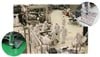
Solid-particle impact damage. Impact type damage results from particles generated either within the steam path itself from detached components, or as a consequence of debris carried over from the boiler and steam leads. Damage of this type is shown in Figure 9.3.1, and appears as a removal of tenon material at the front edge of the head with material deformation, affecting the leading edge of the tenon. Had a foxholed tenon been used in this instance, the damage would have been of...