Overview
Let x = [ x 1 x 2 x M] T be a column vector containing M unknown parameters that are to be estimated and y = [ y 1 y 2 y N] T be a set of noisy measurements that are linearly related to x as described by the expression:
where n = [ n 1 n 2 n N] T is a vector describing the errors corrupting the N measurements, and H is an N M matrix describing the connection between the measurements and x.
The maximum likelihood estimate of x, denoted as  , is defined as (see, for example, [1]):
where p( y/ x) is the probability density function of the measurement y for a fixed value of x.
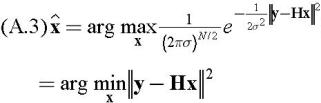
If the measurement errors, { n i}, for i = 1, , N, are identically Gaussian distributed with zero-mean and variance ? 2, and furthermore if errors for different measurements are statistically independent, then (A.2) becomes:
The solution to (A.3) can readily be found by first differentiating y ? H 2 with respect to :
and then setting this quantity equal to zero to obtain:
where it is assumed that the matrix inverse involved exists (i.e., that H T H is not singular).


 TABLE OF CONTENTS