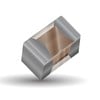
Resistors are very simple devices, and it is easy to explain their basic characteristics and integrated-circuit implementation using simple models. However, the text of this chapter extends well beyond the simplest models needed to explain resistors. The aim is to introduce some very important, although apparently abstract concepts, using the simplicity of resistors as a sound reference. The solid-state physics concepts introduced in this chapter include drift current, diffusion, carrier mobility, carrier concentration, and energy-band model. This chapter also introduces some fundamental microelectronic-device processing steps, namely photolithography and doping by diffusion.
1.1 THE BASICS: RESISTOR STRUCTURE AND DRIFT CURRENT
1.1.1 Integral Form of Ohm's Law
If an electric-potential difference is established between the terminals of a resistor, for example, by connecting the resistor to a voltage source (battery) as shown in Fig. 1.1, a limited current will flow through the resistor. How large a current, I, will flow through the resistor depends on (1) how large the potential difference V = ? 1 - ? 0 is, and (2) how large the resistance, R, of the resistor is. An increase in the potential difference, or in other words the voltage applied across the resistor, increases the current. An increase in the resistance, however, reduces the current. These dependencies are expressed by Ohm's law:
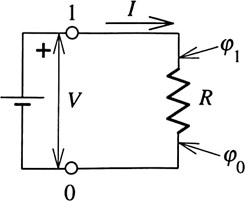 Figure 1.1: Current I induced by voltage V is limited by resistor R.
 1.1.2 Structure of Integrated-Circuit Resistors
As mentioned earlier, the aim of this chapter is to introduce some...
Copyright Oxford University Press, Inc. 2000 under license agreement with Books24x7


 TABLE OF CONTENTS