Diodes are used for a number of different applications, the most frequently being signal rectification, voltage clamping, reference-voltage circuits, light emitters, photodetectors, and solar cells. Usually, the diodes are based on the P-N junction. Therefore, the integrated-circuit structure of the P-N junction capacitor, shown in Fig. 2.3, represents at the same time the integrated-circuit structure of the P-N junction diode, as illustrated in Fig. 3.1. The variety of applications mentioned above can be achieved by specifically designed P-N junction diodes. The rectifying and reference P-N junction diodes are described in the first three sections of this chapter. Simultaneously, the fundamental diode-related phenomena (including breakdown) are introduced. The light emitters, photodetectors, and solar cells are introduced in Chapter 8, simultaneously with a detailed description of recombination-generation processes. The last section of this chapter is devoted to another type of diode, which is based on metal-semiconductor contact. This type of diode sometimes provides more appropriate characteristics for some applications, and also is an integral part of metal-semiconductor field-effect transistors (MESFETs).
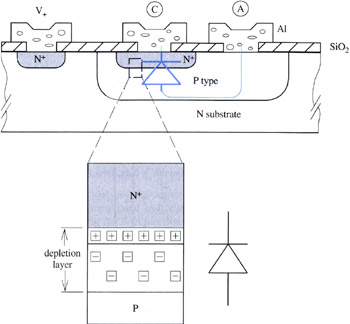 Figure 3.1: Structure of a P-N junction diode in integrated circuits.
 3.1 RECTIFYING DIODES: FUNDAMENTAL EFFECTS AND MODELS
3.1.1 Basic Applications
All the rectifying circuits (the basic rectifying circuit is shown in Fig. 3.2a) necessitate a device that conducts the electric current in one direction only. The current-voltage ( I-V) characteristic of this desired device is shown by the dashed line in Fig. 3.2b. The two possible states of this device are "off" and "on." In the "off" state the current...
Copyright Oxford University Press, Inc. 2000 under license agreement with Books24x7


 TABLE OF CONTENTS