Vacuum Technology: Calculations in Chemistry

Chapter 2: Gas Flow

2.1 INTRODUCTION

Chapter 2 begins by defining essential terms in vacuum technology - gas flow rate, pumping speed, conductance, etc. It also emphasises a basic assumption for calculation - that continuity is established in a system (what enters must eventually leave). Simple equations are stated and their use demonstrated.

In Chapter 1, the types of gas flow that could be established in vacuum systems were defined. This chapter deals with the quantification of viscous and molecular flow for simple, model systems (pipelines of constant, circular cross-section, orifices and apertures, etc.). These are nevertheless useful, and worked examples are presented to encourage users to quantify existing or proposed systems and to provide reassurance that calculations are not only relatively straightforward but very useful indeed.

Flow in the range between viscous and molecular types (sometimes termed Knudsen flow) is also mentioned but quantified only for tubes. It is, however, an additional check for vacuum technologists who tend only to look at the limiting cases to obtain upper and lower values for parameters.

2.2 DEFINITIONS

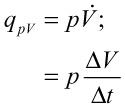
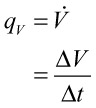
Gas flow rate (gas flux) is expressed in various ways in vacuum technology. The symbols q and Q are commonly used and Table 2.1 contains four definitions.

Table 2.1: Expressions for gas flow rate

Quantity

Equation

Typical units [a]

Mass flow rate

(2.1)

kgs -1

pV flow rate ( pV-throughput)

(2.2)

mbar Ls -1, Pa m 3s -1

Volume flow rate

(2.3)

m 3h -1, Ls -1

UNLIMITED FREE
ACCESS
TO THE WORLD'S BEST IDEAS

SUBMIT
Already a GlobalSpec user? Log in.

This is embarrasing...

An error occurred while processing the form. Please try again in a few minutes.

Customize Your GlobalSpec Experience

Category: Flow Switches
Finish!
Privacy Policy

This is embarrasing...

An error occurred while processing the form. Please try again in a few minutes.