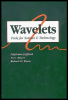
Wavelets: Tools for Science & Technology
In his thesis, "Codage en sous-bandes: th orie et applications la compression num rique du signal de parole," Claude Galand carefully described the quadrature mirror filters (which he invented in collaboration with Esteban and Croisier [68]) and their anticipated applications [125]. He also posed some very important problems that would lead to the discovery of wavelet packets (Chapter7) and Malvar Wilson wavelets (Chapter 6).
Galand's work was motivated by the possibility of improving the digital telephone, a technology that involves transmitting speech signals as sequences of 0's and 1's. However, as Galand remarked, these techniques extend far beyond digital speech, since facsimile, video, databases, and many other forms of information travel over telephone lines. At present, the bit allocation used for telephone transmission is the well-known 64 kilobits per second. Galand sought, by using coding methods tailored to speech signals, to transmit speech well below this standard. To validate the method he proposed, Galand compared it with two other techniques for coding sampled speech: predictive coding and transform coding.
Linear prediction coding amounts to looking for the correlations between successive values of the sampled signal. These correlations are likely to occur on intervals of the order of 20 to 30 milliseconds. This leads one to cut the sampled signal x ( n) into blocks defined by 1 ? n ? N, N + 1 ? n ? 2 N, etc., and then to seek, for each block, coefficients a k, 1 ? k ?