Wavelets: Tools for Science & Technology
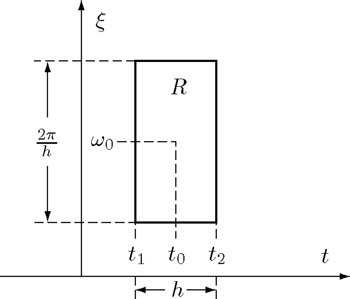
A time-frequency analysis of a signal is a representation of the signal as a linear combination of time-frequency atoms. These time-frequency atoms are essentially characterized by an arbitrary duration t 2 ? t 1 and an arbitrary frequency ?. The instant t 1 is the moment when the signal is first heard (if it is a speech signal, for example), and t 2 is the instant when it ceases to be heard. The frequency ? is an average frequency; this is the frequency of the emitted tone in the case of a musical signal, while the frequency spectrum given by Fourier analysis takes into consideration the parasitic frequencies created by the note's attack and decay.
We also think of a time-frequency atom as occupying a symbolic region in the time-frequency plane (Figure 7.1). This symbolic region is a rectangle R with area 2 ?, which expresses the Heisenberg uncertainty principle.
The most famous example of time-frequency atoms is that of the Gabor wavelets. For these we have f R( t) = e i ?0 t g h( t ? t 0), where
is the center of the time-frequency atom and
, g ( t) = ? ? 1/4 e ? t2/2. In this case, the "size" of the time-frequency atom is approximately h, and h is approximately equal...