Wet-Steam Turbines for Nuclear Power Plants

Chapter 1: The Nuclear Power Industry at the Turn of the 21st Century

The Early History of Nuclear Wet-Steam Turbines

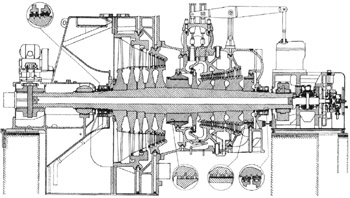
The first kilowatt-hours of electricity from nuclear energy were produced on December 20, 1951, in the United States by a steam turbine generator fed with steam from Experimental Breeder Reactor-I (EBR-I). The turbine had a rated output of 200 kW and initial steam conditions of 2.8 MPa and 220 C (405 psi, 429 F). In 1953, tests began at the shore-based prototype of a steam-turbine unit for the first nuclear-powered U.S. submarine, the Nautilus, and in 1954, the Soviet Union launched the first experimental nuclear power installation, with a rated output of 5 MW. The first commercial power generating unit with a nuclear reactor as a steam supply source was placed in service in 1957 at Shippingport. [1] The Westinghouse turbine of this unit was designed for a rotation speed of 1,800 rpm and a maximum capability rating of 100 MW. It was fed with saturated dry steam, with the inlet steam pressure varying from 3.8 MPa (545 psi) at the maximum load to 5.9 MPa (850 psi) when the reactor was at idle. As shown in Figure 1-1, the turbine was a single-cylinder, single-exhaust machine with 40-inch last stage blades.

Source: J. A. Carlson [2]


Figure 1-1: Westinghouse nuclear wet-steam turbine (100-MW, 1,800 rpm) used at Shippingport Station, 1957

It was the first relatively large wet-steam turbine developed for nuclear power plants. It worked with the steam expansion process occurring primarily in the moisture region. The major problem in this case...

UNLIMITED FREE
ACCESS
TO THE WORLD'S BEST IDEAS

SUBMIT
Already a GlobalSpec user? Log in.

This is embarrasing...

An error occurred while processing the form. Please try again in a few minutes.

Customize Your GlobalSpec Experience

Category: Nuclear Services
Finish!
Privacy Policy

This is embarrasing...

An error occurred while processing the form. Please try again in a few minutes.