WIMAX Explained

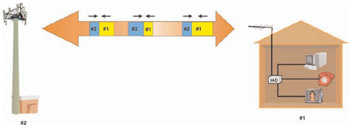
Ranging is a dynamic time alignment process that allows a radio system base station to receive transmitted signals from mobile communication devices in an exact time slot, even though not all mobile communication devices are the same distance from the base station. Ranging keeps different mobile device transmit bursts from colliding or overlapping. Ranging is necessary because subscriber stations may be moving or have been moved, and their radio waves arrival time at the base station depends on their changing distance from the base station. The greater the distance, the more delay in the signal s arrival time. Transmission delay is approximately 3 microseconds per km (or 5 microseconds per mile). To perform time alignment, a subscriber station can advance or delay its transmission timing relative to the reference message that it receives on the downlink channel.
The WiMAX system uses two types of ranging: initial ranging and periodic ranging. During initial ranging, the WiMAX subscriber station transmits a brief ranging request message that allows the system to send back a ranging response message with the amount of timing offset that the subscriber station must use when it begins transmitting. After the subscriber station has attached to the system, the base station will continually send time alignment messages (periodic ranging) to the subscriber station to adjust (fine tune) its timing advance as it moves in the radio coverage area.
Initial ranging is the process of time aligning with...