The popular GSM system is deployed all over the world in more than 197 countries, having provided cellular mobile services to over 863 million people (as of May 2003), and was estimated to have 1 billion people by 2004 [1] , [2]. The primary service provided by GSM is mobile voice communications. We have briefly discussed GSM in Chapter 3. GSM, a 2G system, is evolving to UMTS, a 3G system (the high-level time line for this evolution is shown in Figure 11.1). UMTS is being designed to be a multiservice network that supports higher data rates and multiple new and innovative services (including a variety of data services, not just voice). Of the new wireless IP systems being developed around the world, it is arguably the one that is furthest along in its development and with the most momentum. Thus, UMTS has the potential to be the most widely deployed wireless IP telecommunications system in the world, within a decade.
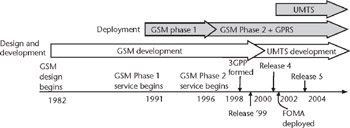 Figure 11.1: Time line for GSM and UMTS development and deployment.
 In this chapter and Chapter 12, we discuss the evolution of GSM to UMTS to provide a perspective on the standards development process of a canonical wireless IP system. Along the way, various relevant issues will be discussed. This chapter is more on the evolutionary process, whereas the next chapter is focused on the IP multimedia sub-system that is foundational in providing IP multimedia services in UMTS. In these two chapters, then, we will see how the...
Copyright Artech House, Inc. 2005 under license agreement with Books24x7

 TABLE OF CONTENTS