Digital and Analogue Instrumentation: Testing and Measurement
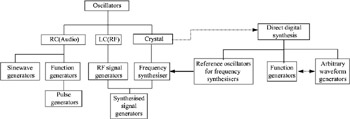
Test systems often require you to create different types of waveforms. To meet this requirement the world of instruments uses different families of waveform, signal and data generators falling in to a family tree of signal sources as shown in Figure 8.1. Most traditional waveform or function generators and the signal generators provide you with either (i) sine, square, triangular or variations and combinations, or (ii) high frequency sine waveforms with miscellaneous types of modulation. The first type is used for testing miscellaneous types of analogue, mixed signal or digital circuit blocks, whereas the second category is used for testing communication systems in general. Reference 1 provides a detailed account of these analogue systems and design techniques.
In the world of digital instruments where the user is able to obtain an arbitrary waveform based on information stored in a memory, many new families have entered the market during the past two decades. This chapter provides an overview of the design techniques, advantages and limitations of conventional and arbitrary output instrument families and some applications.
This traditional group includes function, pulse, audio and signal generators as well as swept frequency oscillators. The following is a summary of these conventional investments.
Basic function generators supply sine, square and triangle waves with frequencies ranging from 1 mHz to over 50 MHz. A basic function generator using two operational amplifiers and other components is shown in Figure 8.2.