Digital and Analogue Instrumentation: Testing and Measurement
Counting the occurrence of electrical events was a primary concern of electrical engineering, even in the era of vacuum tubes. The first-generation electronic counters were designed using vacuum tubes; these were bulky, heavy and power hungry. The second-generation counters introduced in the early 1960s were considerably smaller owing to transistorised circuitry even though the basic specifications of the instruments remained more or less the same as for the vacuum tube versions. The availability of digital integrated circuits at the end of 1960s led to the birth of a third generation with better performance and features. With the introduction of LSI and VLSI components, a fourth generation of powerful counters has appeared in the market within the past 15 years. Very recently, related families of instruments, such as modulation domain analysers, have also been introduced into the industry, thus bringing unique methods for viewing complex modulated signals in the modulation domain.
Basic concepts related to the electronic counters which can be used to measure frequency, time, phase, frequency ratio, time interval average, etc., will be discussed in this chapter with special reference to accuracy and modes of operation. Further, some techniques for frequency measurements in the microwave region will be discussed with a brief introduction to modulation domain analysis.
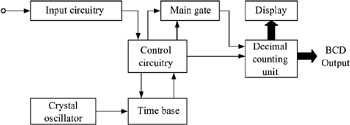
A counter can be divided into five basic blocks as shown in Figure 7.1. These are: (i) input circuit, (ii) main gate, (iii) decimal counting unit and display, (iv) time base, and (v) control circuit.