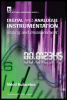
Digital and Analogue Instrumentation: Testing and Measurement
Obtaining accurate, reliable and cost effective measurements depends on the instrument, the user and the mathematical treatment of the measured results. Proper selection, use of instruments and interpretation of measurement are the responsibilities of the user. A person's basic ability to make an intelligent selection and to use the instrument properly is greatly increased by an understanding of the basic theory of operation and the capabilities and limitations of the instrument families. Almost all families of test and measuring instruments give the user a set of values of a parameter that is of interest to the user. To interpret these parameter values more meaningfully some basic terms and techniques could be used.
The past two decades (1980 2000) could be cited as the maturity period for developments in digital instruments as well as the developments in interfacing, remote measurements and data management. During the 1990s, the ISO 9000 series of standards proliferated in the industry as a means of ensuring the quality and uniformity for procedures adopted in the production and service management. Adherence to quality standards such as the ISO 9000 series created a growing need for emphasis on measurement and calibration. With these developments many metrology laboratories are using personal computers to increase productivity and to collect and report information required by these standards. Raw or partly processed data available from the measuring instruments could be better interpreted when the user has a clear picture of definitions of the base units and the derivations...