Digital and Analogue Instrumentation: Testing and Measurement
As the engineering community progresses with technological developments, sophisticated measuring instruments become a major requirement for the interpretation of performance, parameter comparison and improvements. However, in most engineering environments, basic instruments for the measurement of V, I, R, Z and temperature, etc., account for the major share of the instrument market.
In practical environments, such as the field service and maintenance workshops, etc., simple instruments, such as multimeters, are used to measure signals without paying any attention to the wave shape, signal frequency components, or to the instruments' capabilities or limitations. In digital system environments, pulse waveforms are used for device characterisation and performance checking. In such situations, pulse parameters and techniques play an important role, forcing the designer, service or the test engineer to understand pulse parameters and test techniques.
This chapter provides an overview of waveform measurements, multimeters and pulse techniques.
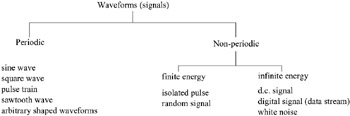
Most waveforms may be divided into periodic and non-periodic signals. Furthermore, the non-periodic signals may be subdivided into finite and infinite energy signals. The chart in Figure 4.1 shows some practical signals grouped into these categories.
Each kind of waveform has its inherent features and qualities and several parameters have been defined to specify and evaluate the same. Table 4.1 indicates different parameters for different types of waveform, dividing them into primary and secondary categories in relation to the practical usage of these signals.