|
||
|
FREE GlobalSpec e-Newsletters
Receive the latest news, trends, and technology relevant to your work. (See Titles) |
|
From Programming the PIC Microcontroller with MBasic
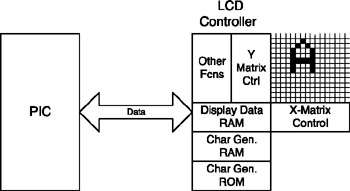
OverviewBlinking an LED is fine, as far as it goes, but it limits our communications opportunity with the outside world. If users are not to learn Morse code, a text-based message display expands our communications horizon greatly. Liquid Crystal Displays have become the display of choice for PIC output for good reasons; they are relatively inexpensive, have built-in support in MBasic and are available in a variety of sizes. We'll deal exclusively with LCD modules supported by MBasic. An LCD module includes both the display and a controller board, as shown in Figure 5-1. Don't buy inexpensive LCD displays sold by some surplus stores without the controller board they are not compatible with MBasic's LCD functions. Almost universally, LCD modules use an Hitachi HD44780 controller/driver chip, or a derivative chip compatible with the HD44780 command set, such as Samsung's KS0066 or Epson/ Seiko's SED1278. (An HD44780 only supports a 16-character display, but with auxiliary chips will control up to an 80-character display.) Figure 5-1: Main LCD module elements. The particular display we'll use in our experiments is a Tianma TM162YBC6, 2-line, 16 characters per line display, super twisted nematic technology with LED backlighting, available from Basic Micro, as shown in Figure 5-2. However, almost any LCD module may be substituted for this display with little or no modifications to the hardware or software developed in this chapter. Figure 5-2: TM162YBC6 LCD display. The TM162YBC6's controller chip is a KS0066, U1 in Figure 5-3. In this product, the KS0066...
Copyright Elsevier Inc. 2005 under license agreement with Books24x7
Products & Services
Liquid crystal display (LCD) modules are used at the component level in place of less efficient displays such as cathode ray tubes (CRTs). These modules do not include a housing and must be incorporated into a larger instrument or system.
Search by Specification |
Learn more about Liquid Crystal Display (LCD) Modules
LCD drivers are semiconductor chips used to power and control liquid crystal displays (LCDs).
Learn more about LCD Drivers
Flat panel displays (FPDs) are thin, flat, electronic devices used to display data. They are commonly used in notebook computers. Most styles include the housing and ports necessary to connect them to a computer.
Search by Specification |
Learn more about Flat Panel Displays
Commercial matrix displays include any type of display used in commercial applications.
Learn more about Commercial Matrix Displays
LCD switches and LED switches contain an integrated liquid crystal display (LCD) or light emitting diodes (LED) that show text and graphics. They can be programmed to perform specific functions and provide choices for the selected operation.
Learn more about LCD Switches and LED Switches
Product Announcements
Topics of Interest
Chapter 4 looked at reading individual switches and a matrix keypad. We'll extend our switch reading to look at additional pin saving techniques. We'll also see how rotary encoders both internally...
(Read More)
Overview
In this chapter, I provide you with a software module that will allow you to interface with character LCD (Liquid Crystal Display) modules. This software package works with just about any...
(Read More)
In many respects, an LCD module is an ideal display; easy to use, available in a wide choice of sizes and capacity and supported in MBasic with one easy-to-use function, LCDWrite. But, as good as LCD...
(Read More)
This application note interfaces a micrange PICmicro device to a Hitachi LM032L LCD character display module, with a two line by twenty character display. LCD modules are useful for displaying text...
(Read More)
A port contains a set of signal lines that the CPU uses to send or receive data with other components. Ports are usually used to communicate via modem, printer, keyboard, mouse, etc. In signaling,...
(Read More)
|
|