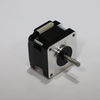
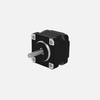
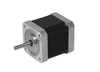
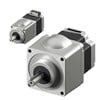
Stepper motors, as the name implies, rotate in discrete steps. Most conventional motors are continuous; if we make a mark on the shaft of a conventional motor and if we were able to precisely control the motor's excitation, we could make the shaft move to any angle. 123.456 degrees from the starting mark is just as achievable as 321.765 degrees. Of course, practical considerations make this degree of precision unlikely in a real motor. A stepper motor's shaft, in contrast, is moveable to only certain, pre-defined angles. A 48-step stepper motor, for example, may be positioned only in increments of 7.5 degrees (360 /48). Hence, we may command the shaft to go to 7.5 (one step) or 15 (two steps) but not to 8.432 . (Later in this chapter, and in Chapter 19, we'll see ways to step the shaft rotation one-half or a smaller fraction of the motor's normal step size, so the difference between conventional and stepper motors blurs.)
Why would we want a motor that only moves in steps? Suppose we wish to move an ink jet printer's print head across the paper, and that we must position the print head with an accuracy of 0.001". We'll assume the print head is attached to a nonslip, no stretch toothed belt and that the belt is driven through a toothed pulley system attached to a positioning motor. Let's attach a 200-step stepper motor to the pulley, through 5:1 step down gears, and pick the pulley size so that 1, 000...
Copyright Elsevier Inc. 2005 under license agreement with Books24x7


 TABLE OF CONTENTS