Photonic Glasses
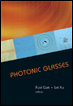
Introducing the fundamental mechanism of photonic glasses, this book puts emphasis on new developments in the structure, spectroscopy and physics of new glassy materials for photonics applications.
 TABLE OF CONTENTS
 Since the born of the first laser in 1960 with ruby as active medium, several kinds of laser materials have been developed. They include crystals, gas, semiconductors and dyes. Crystal media are boasted for their high strength, however, the "thermal lens" effect resulted from their poor optical homogeneity deteriorates the laser performance. The strength and lifetime of gas as laser materials are limited. The lifetime and strength of semiconductors are both high and the laser configuration can be very compact, but the tuning range is only several nanometers. Laser dyes can be used in solid or liquid, their concentration can be readily controlled and the laser wavelength can be tuned continuously over a very wide spectrum range, producing narrow linewidth laser pulses without substantial energy loss. Also, organic dyes are very cheap. At present, dye lasers are still the major tunable laser sources. Because of the above characteristics, dye lasers have found extremely wide applications in industry, military, environment monitoring, medical diagnoses and therapy, laboratory and optical communication. In scientific research, tunable dye laser is especially useful in spectroscopy, biology, holography, photochemistry, isotope separation, non-linear optics and integrated optics, etc. Dye lasers in early stage mainly use liquid solution as active media. Since mid 1980s, intensive efforts have been devoted to the research on all solid state dye laser media and devices. In this chapter, a brief review is given on the history, recent progress and developing trends in this field, especially for hybrid organic-inorganic solid state dye laser...