Active Filters for Integrated-Circuit Applications

Chapter 8: The Approximation Problem

8.1 Traditional Methods

So far we have studied how to build filters to provide specified frequency response either by scaling or transforming given prototype designs or by designing from specified network functions. Most filter design is done this way; however, there are occasional instances where given prototypes don't quite provide the required response. When that happens, it is useful to be able to generate a desired prototype, or network function, to provide the required performance. Finding a suitable network function, as a ratio of polynomials in the complex frequency variable, s, is referred to as the approximation problem. This chapter provides an introduction to traditional methods that are used to find suitable network functions and concludes by presenting a general method to find a suitable polynomial ratio to fit specified loss functions.

8.1.1 Ideal LP Filter Characteristics

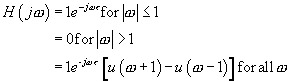
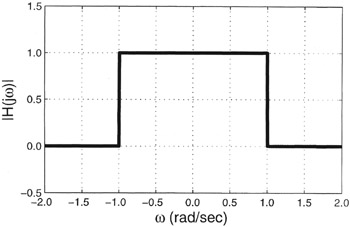
The sinusoidal frequency response magnitude function for an ideal filter is shown in Figure 8.1. It passes energy without loss for the frequency band, -1 < ? < +1 rad/sec, and provides infinite loss for all frequencies, ? > 1, that lie outside the passband. The transition bandwidth from passband to stopband is zero; thus, the filter has a shape factor, [1] SF = (1 + 0)/1 = 1. It is useful to determine the impulse function associated with this ideal function. Using H( j ?), described in (8.1), we get the following impulse response for the ideal characteristic from its inverse Fourier transform:

(8.1)

Figure...

UNLIMITED FREE
ACCESS
TO THE WORLD'S BEST IDEAS

SUBMIT
Already a GlobalSpec user? Log in.

This is embarrasing...

An error occurred while processing the form. Please try again in a few minutes.

Customize Your GlobalSpec Experience

Category: IC Electronic Filters
Finish!
Privacy Policy

This is embarrasing...

An error occurred while processing the form. Please try again in a few minutes.