Active Filters for Integrated-Circuit Applications

In the last chapter, we learned about state variable and other architectures used to synthesize linear network functions directly from a specified ratio of polynomials in the complex frequency variable, s. So far, we have not considered what is referred to as network sensitivity to element value variations and environmental factors. In this chapter, we look at a formal definition for the sensitivity factor and then at a particular active circuit architecture, called leapfrog, that is used to emulate low-sensitivity performance of passive ladder networks. Once again, operational ideas are used to realize a particular set of equations and to achieve a desired network function.
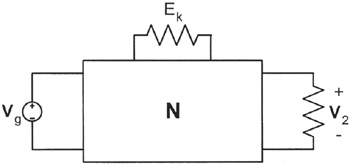
Filter sensitivity to specific element value variation is visualized as shown in the circuit in Figure 6.1. The network function, V 2/ V g, has an implicit dependence upon the kth element, E k, of the network. Usually, we are interested in some parameter, P, of T( s), such as the 3-dB bandwidth, peak gain, or anything that depends upon some other parameter, x. The other parameter can be a circuit element value or any environmental variable, such as temperature. The sensitivity of parameter P with respect to x is represented by the function,
. It is defined as in (6.1):
| (6.1) | |
A particular sensitivity factor reflects the change obtained in...