Active Filters for Integrated-Circuit Applications

Chapter 5: Operational Design of Active Filters

Overview

The purpose of the previous chapters was to provide background on the design and use of opamps for negative feedback applications. We learned that the high-gain opamp is a complex circuit with nonideal behavior. The knowledge of opamp design and performance helps the filter designer to be aware of limitations in the use of opamps in terms of intended signal ranges, signal bandwidths, and operating temperatures. Most filters carry specifications in all of these areas, so ultimately, the filter designer must test and guarantee performance for a final design.

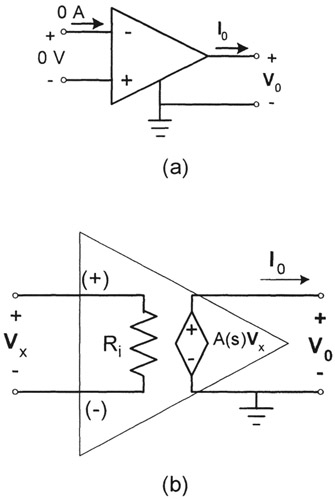
However, in order to simplify concepts for the initial feasibility part of a design, it is customary to use the simple opamp linear small-signal model shown in Figure 5.1(a). This model provides no information about any of the above operating parameters, but it allows simple circuit analysis based on the limit large gain (infinity) times a vanishingly small input (zero) that yields a finite output voltage, V 0. The result is that the opamp imposes a constraint on the connected feedback circuit so as to force 0 V across the amplifier input. At the same time the opamp provides whatever load current and voltage the feedback circuit requires in order-to satisfy the zero input requirement of the opamp. This opamp model has no frequency-, thermal-, or dynamic-range-dependent information.


Figure 5.1: Simplified opamp models for linear dynamic signal analysis (a) conventional opamp model, and (b) second-order dynamic model.

The model of Figure 5.1(b) is used as a second-order model to estimate opamp...

UNLIMITED FREE
ACCESS
TO THE WORLD'S BEST IDEAS

SUBMIT
Already a GlobalSpec user? Log in.

This is embarrasing...

An error occurred while processing the form. Please try again in a few minutes.

Customize Your GlobalSpec Experience

Category: Active High Pass Filters
Finish!
Privacy Policy

This is embarrasing...

An error occurred while processing the form. Please try again in a few minutes.