Active Filters for Integrated-Circuit Applications

This appendix presents a plausibility derivation for the Hilbert transform used in this chapter and a complete code listing for the approximation problem, apprx8.
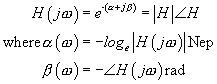
The Hilbert transform, (8.40), was used without derivation to find the phase lag, ?, from a given loss, ?, in the following network function representation:
| (8A.1) | |
? = ?+ j ? is the network propagation constant, and it is a complex number function of frequency ? with real part ? and imaginary part ?. Generally, in filter design, the loss, ?( ?), is specified, and the phase lag, ?( ?), is unknown or unspecified. In order to find a ratio of polynomials to best fit the specified loss function, it was found useful to use the phase-lag function in order to develop an initial set of polynomials derived from the specified function, ?( ?). This required the use of the Hilbert transform to obtain an estimate of ? from ?.
A straightforward way to obtain this transform is to consider the imaginary part associated with the real part of a single pole as it is allowed to coincide with the origin. The result obtained from this limiting procedure yields an impulse for the real part associated (or paired) with - j/ ? for the imaginary part. Thus, any given real function of ? can be...