Allan's Circuits Problems

ANALYSIS USING THE IDEAL OP-AMP MODEL
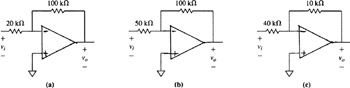
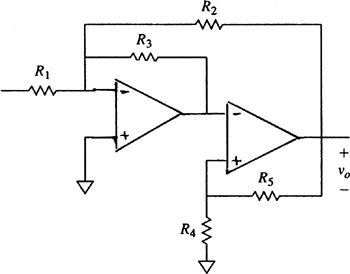
| 1. | Determine the voltage gain and the input resistance for each of the ideal operational amplifier circuits of Fig 4.1. Figure 4.1 |
|
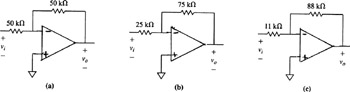
| 2. | Determine the voltage gain and the input resistance for each of the ideal operational amplifier circuits of Fig 4.2. Figure 4.2 |
|
| 3. | Determine the voltage gain of the ideal operational amplifier circuit of Fig 4.3. Figure 4.3 |
|
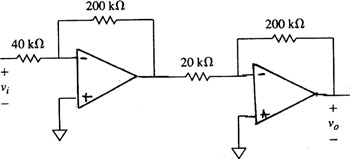
| 4. | Determine the ratio, v o/ v i, in the ideal operational amplifier circuit of Fig 4.4. Figure 4.4 |
|
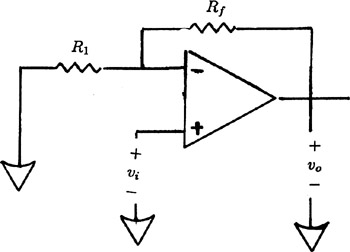
| 5. | For the ideal operational amplifier shown in Fig 4.5, determine the gain G = v o/ v i, for the conditions of (a) R 1 = 100 k ? and R f = 900 k ?, (b) R 1 = 50 k ? and R f = 750 k ? and (c) R 1 = 100 k ? and R f = 1.1 M ?. Figure 4.5 |
|
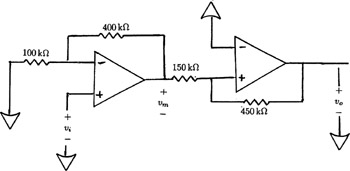
| 6. | For the ideal operational amplifier arrangement shown in Fig 4.6, determine the output voltage, v o if the input voltage, v i, is equal to 1.20 V. Figure 4.6 |
|
| 7. | Figure 4.7 shows an ideal operational amplifier connected as a differential amplifier. Both the inverting and non-inverting terminals are used. Determine an expression for the output voltage, v o, as a function of v i1 and v i2 [ v o |