Allan's Circuits Problems

Chapter Four: The Operational Amplifier

ANALYSIS USING THE IDEAL OP-AMP MODEL

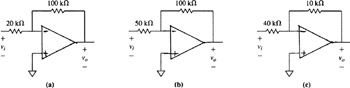
1.

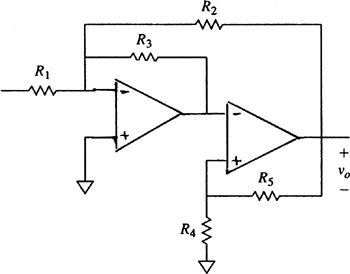
Determine the voltage gain and the input resistance for each of the ideal operational amplifier circuits of Fig 4.1.


Figure 4.1

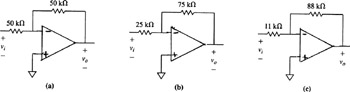
2.

Determine the voltage gain and the input resistance for each of the ideal operational amplifier circuits of Fig 4.2.


Figure 4.2

3.

Determine the voltage gain of the ideal operational amplifier circuit of Fig 4.3.


Figure 4.3

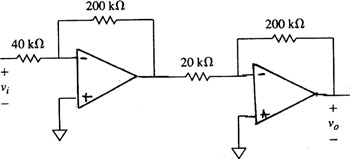
4.

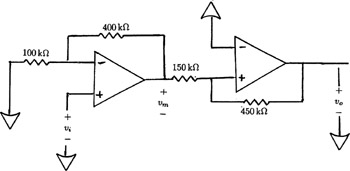
Determine the ratio, v o/ v i, in the ideal operational amplifier circuit of Fig 4.4.


Figure 4.4

5.

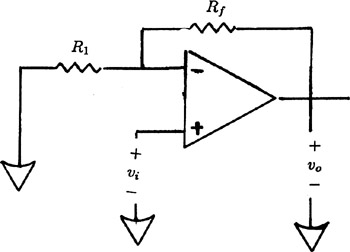
For the ideal operational amplifier shown in Fig 4.5, determine the gain G = v o/ v i, for the conditions of (a) R 1 = 100 k ? and R f = 900 k ?, (b) R 1 = 50 k ? and R f = 750 k ? and (c) R 1 = 100 k ? and R f = 1.1 M ?.


Figure 4.5

6.

For the ideal operational amplifier arrangement shown in Fig 4.6, determine the output voltage, v o if the input voltage, v i, is equal to 1.20 V.


Figure 4.6

7.

Figure 4.7 shows an ideal operational amplifier connected as a differential amplifier. Both the inverting and non-inverting terminals are used. Determine an expression for the output voltage, v o, as a function of v i1 and v i2 [ v o

UNLIMITED FREE
ACCESS
TO THE WORLD'S BEST IDEAS

SUBMIT
Already a GlobalSpec user? Log in.

This is embarrasing...

An error occurred while processing the form. Please try again in a few minutes.

Customize Your GlobalSpec Experience

Category: Logarithmic Amplifier Chips
Finish!
Privacy Policy

This is embarrasing...

An error occurred while processing the form. Please try again in a few minutes.