Allan's Circuits Problems

Chapter Six: Thevenin, Norton and Maximum Power Transfer Theorems

THEVENIN AND NORTON THEOREMS FOR NETWORKS WITHOUT CONTROLLED SOURCES

1.

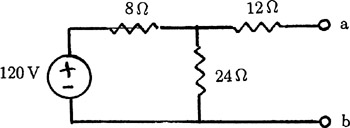
Use Thevenin's theorem to find the resistance that must be connected across terminals a-b in Fig 6.1 in order for the resistor current to be 3 A.


Figure 6.1

2.

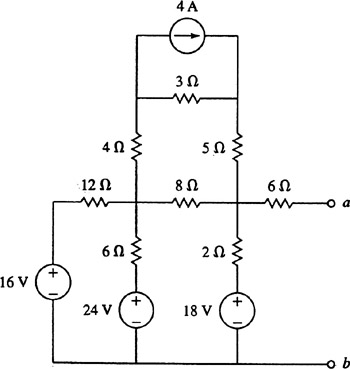
Determine the Thevenin equivalent network between terminals a-b in Fig 6.2.


Figure 6.2

3.

Use Thevenin's theorem to find the current, I, in the network of Fig 6.3.


Figure 6.3

4.

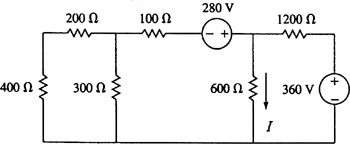
Use Thevenin's theorem to find the current, I, flowing through the 600 ? resistor in the network of Fig 6.4.


Figure 6.4

5.

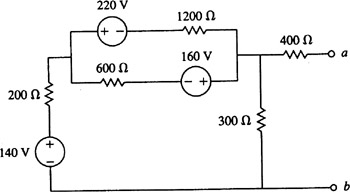
Determine the Norton equivalent circuit for terminals a-b in the network of Fig 6.5.


Figure 6.5

6.

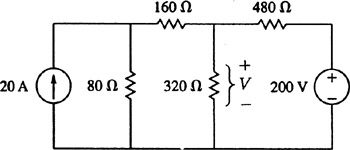
Use Thevenin's theorem to find the voltage across the 320 ? resistor in the network of Fig 6.6.


Figure 6.6

7.

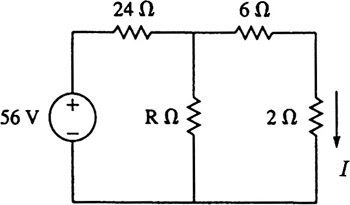
Use the Thevenin's theorem or the Norton's theorem to determine the value of R that will allow a current of 1 A to flow through the 2 ? resistor in Fig 6.7.


Figure 6.7

8.

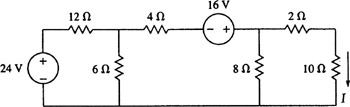
Use Norton's theorem to determine the current through the 10 ? resistor in the network of Fig 6.8.


Figure 6.8

THEVENIN AND NORTON THEOREMS FOR NETWORKS WITH CONTROLLED SOURCES

9.

Use Thevenin's theorem to determine the power dissipated by the 12 ? resistor in Fig 6.9.


Figure 6.9

10.

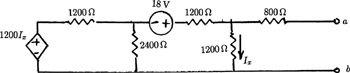
Determine the Norton equivalent for terminals a-b in the network of Fig 6.10.


Figure 6.10

11.

Use Thevenin's theorem to determine the...

UNLIMITED FREE
ACCESS
TO THE WORLD'S BEST IDEAS

SUBMIT
Already a GlobalSpec user? Log in.

This is embarrasing...

An error occurred while processing the form. Please try again in a few minutes.

Customize Your GlobalSpec Experience

Category: Current Sensing Resistors
Finish!
Privacy Policy

This is embarrasing...

An error occurred while processing the form. Please try again in a few minutes.