Biosolids Engineering

Authored by a diplomate of the American Academy of Environmental Engineers, this expert guide offers professional help for designing and managing a biosolids program and decreasing the burden on landfills.
 TABLE OF CONTENTS
 Biosolids are the residual solids generated from the processing of municipal wastewater (excluding grit and bar screenings) and domestic septage that meet the regulatory requirements for recycling (i.e., beneficial use) specified in the 40 CFR Part 503 rule. Once generated, beneficial use (i.e., land application of biosolids for agricultural or aesthetic purposes) represents a cost-effective disposal option for biosolids. To properly design biosolids beneficial-use systems, it is important to understand the impact of wastewater quality objectives on biosolids characteristics and production rates (Fig. 2.1).
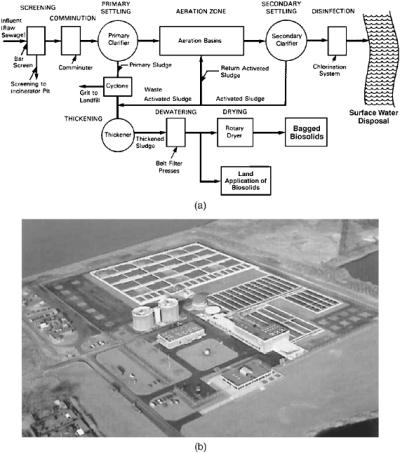
Municipal wastewater consists of liquid wastes produced in residences, commercial establishments, industries, and any subsurface, surface, or storm water that enters the municipal wastewater collection system. Depending on the type and extent of wastewater treatment, any of the materials that enter the municipal wastewater collection system ultimately may find their way into biosolids.
Effective treatment of wastewater requires an accurate knowledge of its influent quality. Since wastewater influent is not constant in character from place to place nor from time to time, the biosolids resulting from its treatment would be expected to vary as well. The principal constituents of wastewater are summarized in Table 2.1.
| Physical constituents | Chemical constituents | Biological constituents | |
|---|---|---|---|
| Organic | Inorganic | ||
| Color | Carbohydrates | Alkalinity | Animals |
| Odor |