Biosolids Engineering

Authored by a diplomate of the American Academy of Environmental Engineers, this expert guide offers professional help for designing and managing a biosolids program and decreasing the burden on landfills.
 TABLE OF CONTENTS
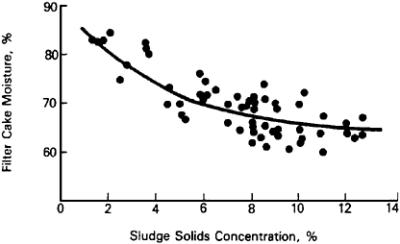
 Thickening is normally the first processing operation after raw sludge has been generated at the wastewater treatment plant. Thickening is defined as the removal of water from sludge to achieve an overall volume reduction. Volume reduction is desirable to reduce both the capital and operational costs of subsequent sludge-processing steps. For example, thickening from a 1 to a 2 percent solids concentration reduces the sludge volume by 50 percent, whereas increasing the solids content from 1 to 5 percent reduces the volume by 80 percent. Such levels of volume reduction will have a significant impact on the sizing of tanks, pumps, and other downstream sludge-processing equipment. Figure 3.1 illustrates the impact of sludge thickening on the final moisture content achieved in a dewatered sludge cake.
An important physical characteristic of thickened biosolids/sludge is that the resulting material is still fluid (i.e., pumpable). Therefore, the thickened biosolids/sludge may be conveyed within the wastewater treatment plant or to the land-application site by pipeline. The fluidity of the material after processing is a critical distinction between biosolids/sludge thickening and dewatering operations. Dewatered biosolids/sludges are not pumpable and therefore must be conveyed within and outside the wastewater treatment facility by means other than a pipeline (e.g., front-end loader, belt conveyor, truck, rail, barge, etc.). Transportation options for both thickened and dewatered biosolids/sludge are covered in Chap. 5.
Biosolids/sludge thickening generally is accomplished by...