Circuit Analysis I with MATLAB Applications

This chapter is an introduction to inductance and capacitance, their voltage-current relationships, power absorbed, and energy stored in inductors and capacitors. Procedures for analyzing circuits with inductors and capacitors are presented along with several examples.
In the first four chapters we considered resistive circuits only, that is, circuits with resistors and constant voltage and current sources. However, resistance is not the only property that an electric circuit possesses; in every circuit there are two other properties present and these are the inductance and the capacitance. We will see through some examples that will be presented later in this chapter, that inductance and capacitance have an effect on an electric circuit as long as there are changes in the voltages and currents in the circuit.
The effects of the inductance and capacitance properties can best be stated in simple differential equations since they involve the changes in voltage or current with time. We will study inductance first.
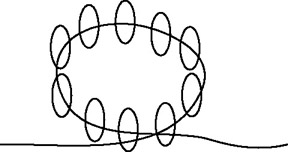
Inductance is associated with the magnetic field which is always present when there is an electric current. Thus, when current flows in an electric circuit the conductors (wires) connecting the devices in the circuit are surrounded by a magnetic field. Figure 5.1 shows a simple loop of wire and its magnetic field represented by the small loops.
The direction of the magnetic field (not shown) can be determined by the left-hand rule if conventional current flow is assumed, or...