Circuit Analysis I with MATLAB Applications

This chapter begins with the basic definitions in electric circuit analysis. It introduces the concepts and conventions used in introductory circuit analysis, the unit and quantities used in circuit analysis, and includes several practical examples to illustrate these concepts.
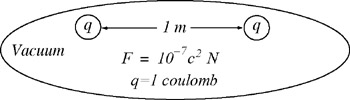
Two identically charged (both positive or both negative) particles possess a charge of one coulomb when being separated by one meter in a vacuum, repel each other with a force of 10 ?7 c 2 newton where c = velocity of light ? 3 10 8 m/s. The definition of coulomb is illustrated in Figure 1.1.
The coulomb, abbreviated as C, is the fundamental unit of charge. In terms of this unit, the charge of an electron is 1.6 10 ?19 C and one negative coulomb is equal to 6.24 10 18 electrons. Charge, positive or negative, is denoted by the letter q or Q.
Electric current i at a specified point and flowing in a specified direction is defined as the instantaneous rate at which net positive charge is moving past this point in that specified direction, that is,
The unit of current is the ampere abbreviated as A and corresponds to charge q moving at the rate of one coulomb per second. In other words,
| Note | Although it is known that... |