Circuit Analysis I with MATLAB Applications

3.4: Transformation between Voltage and Current Sources

3.4 Transformation between Voltage and Current Sources

In the previous chapter we stated that a voltage source maintains a constant voltage between its terminals regardless of the current that flows through it. This statement applies to an ideal voltage source which, of course, does not exist; for instance, no voltage source can supply infinite current to a short circuit. We also stated that a current source maintains a constant current regardless of the terminal voltage. This statement applies to an ideal current source which also does not exist; for instance, no current source can supply infinite voltage when its terminals are open-circuited.

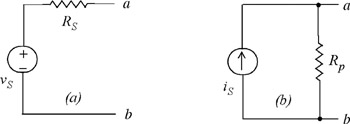
A practical voltage source has an internal resistance which, to be accounted for, it is represented with an external resistance R S in series with the voltage source v S as shown in Figure 3.18 (a). Likewise a practical current source has an internal conductance which is represented as a resistance R p (or conductance G p) in parallel with the current source i S as shown in Figure 3.18 (b).


Figure 3.18: Practical voltage and current sources

In Figure 3.18 (a), the voltage of the source will always be v S but the terminal voltage v ab will be v ab = v S ? v R s if a load is connected at points a and b. Likewise, in Figure 3.18 (b) the current of

the source will always i S be...

UNLIMITED FREE
ACCESS
TO THE WORLD'S BEST IDEAS

SUBMIT
Already a GlobalSpec user? Log in.

This is embarrasing...

An error occurred while processing the form. Please try again in a few minutes.

Customize Your GlobalSpec Experience

Category: LCR Meters
Finish!
Privacy Policy

This is embarrasing...

An error occurred while processing the form. Please try again in a few minutes.