Circuit Analysis I with MATLAB Applications

3.6: Norton's Theorem

3.6 Norton's Theorem

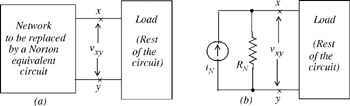
This theorem is analogous to Thevenin's theorem and states that we can replace everything, except the load, in a circuit by an equivalent circuit containing only an independent current source which we will denote as i N in parallel with a resistance which we will denote as R N, as shown in Figure 3.46.


Figure 3.46: Replacement of a network by its Norton equivalent

The current source i N has the value of the short circuit current which would flow if a short were connected between the terminals x and y, where the Norton equivalent is inserted, and the resistance R N is found from the relation


where v OC is the open circuit voltage which appears across the open terminals x and y.

Like Thevenin's, Norton's theorem is most useful when a series of computations involves changing the load of a network while the rest of the circuit remains unchanged.

Comparing the Thevenin's and Norton's equivalent circuits, we see that one can be derived from the other by replacing the Thevenin voltage and its series resistance with the Norton current source and its parallel resistance. Therefore, there is no need to perform separate computations for each of these equivalents; once we know Thevenin's equivalent we can easily draw the Norton equivalent and vice versa.

Example 3.11

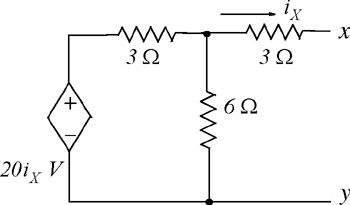
Replace the network shown in Figure 3.47 by its Thevenin and Norton equivalents.


Figure 3.47: Network for Example 3.11

Solution:

We...

UNLIMITED FREE
ACCESS
TO THE WORLD'S BEST IDEAS

SUBMIT
Already a GlobalSpec user? Log in.

This is embarrasing...

An error occurred while processing the form. Please try again in a few minutes.

Customize Your GlobalSpec Experience

Category: Active Low Pass Filters
Finish!
Privacy Policy

This is embarrasing...

An error occurred while processing the form. Please try again in a few minutes.