From Standard Handbook for Civil Engineers, Fifth Edition

Shallow Foundations

Shallow foundation systems can be classified as spread footings, wall and continuous (strip) footings, and mat (raft) foundations. Variations are combined footings, cantilevered (strapped) footings, two-way strip (grid) footings, and discontinuous (punched) mat foundations.

Combined footings (Fig. 7.7) are used where the bearing areas of closely spaced columns overlap. Cantilever footings (Fig. 7.8) are designed to accommodate eccentric loads.
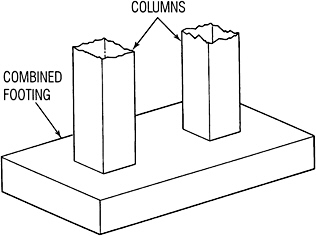

Figure 7.7: Combined footing.

Figure 7.8: Cantilever footing.

Continuous wall and strip footings (Fig. 7.9) can be designed to redistribute bearing-stress concentrations and associated differential settlements in the event of variable bearing conditions or localized ground loss beneath footings.
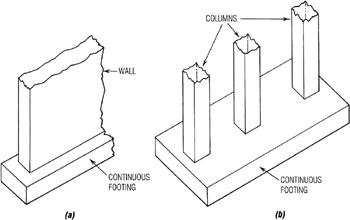

Figure 7.9: Continuous footings for (a) a wall, (b) several columns.

Mat foundations have the greatest facility for load distribution and for redistribution of subgrade stress concentrations caused by localized anomalous bearing conditions. Mats may be constant section, ribbed, waffled, or arched. Buoyancy mats are used on compressible soil sites in combination with basements or subbasements, to create a permanent unloading effect, thereby reducing the net stress change in the foundation soils.

(M.J.Tomlinson, Foundation Design and Construction, John Wiley & Sons, Inc, New York (www.wiley.com); J.E.Bowles, Foundation Analysis and Design, McGraw-Hill Book Company, New York. (books.mcgraw-hill.com) Spread Footings for Highway Bridges, Federal Highway Administration, Publication No. FHWA-RD-86 185 October, 1987)

7.9 Approach to Foundation Analysis

Shallow-foundation analysis and formulation of geotechnical design provisions are generally approached in the following steps:

  1. Establish project objectives and design or evaluation conditions.

  2. Characterize site stratigraphy and soil...

Copyright The McGraw-Hill Companies, Inc. 2004 under license agreement with Books24x7

Products & Services
Concrete Construction and Foundation Services
Forming and installation of structural concrete for foundations, subgrade walls, stairways, walkways, floors, footings and other structural applications. Forms are put in place, reinforcement bars are positioned for strength, concrete is poured and the forms removed. Concrete block construction is included in this group.
Geotechnical Services
Geotechnical engineering services includes soil, rock and subsurface testing and analysis for site feasibility, foundations, embankments, pavements, retention structures, and other earthworks projects.
Excavating Services
Excavating services perform digging, earth moving, earthwork, land clearing, and topsoil removal services to prepare an area for construction or below-ground service activities.
Safety Mat Controllers
Safety mat controllers monitor areas where injury is possible due to moving mechanical parts or other similar hazards. When pressure is detected on a mat, a stop signal is sent to the surrounded machine.
Cantilever Pumps
Cantilever pumps are centrifugal pumps used in sump pump applications. They are available in horizontal and vertical configurations. Many styles including submersible motors.

Topics of Interest

Deep Foundations Subsurface conditions, structural requirements, site location and features, and economics generally dictate the type of foundation to be employed for a given structure. Deep...

Robert W. Day, P.E. ALLOWABLE FOUNDATION MOVEMENT A foundation is defined as that part of the structure that supports the weight and loads acting on the structure and transmits this load to...

Foundations for Buildings Types of Foundation Structure The design of foundations embodies three essential operations, namely, calculating the loads to be transmitted by the foundation structure...

4.1 INTRODUCTION Spread footings and mat foundations are generally classified as shallow foundations. These foundations distribute the loads from the superstructures to the soil on which they are...

7.1 INTRODUCTION Limit analysis is applied in this Chapter to obtain upper and lower bounds for the average bearing capacity pressure q 0 of square, rectangular and circular footings on a purely...