Digital Video and HDTV Algorithms and Interfaces

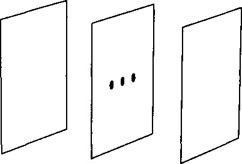
In Chapter 16, Filtering and sampling, on page 141, I described how to analyze a signal that is a function of the single dimension of time, such as an audio signal. Sampling theory also applies to a signal that is a function of one dimension of space, such as a single scan line (image row) of a video signal. This is the horizontal or transverse domain, sketched in Figure 18.1 in the margin. If an image is scanned line by line, the waveform of each line can be treated as an independent signal. The techniques of filtering and sampling in one dimension, discussed in the previous chapter, apply directly to this case.
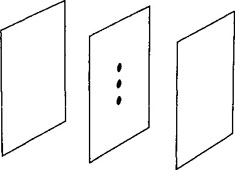
Consider a set of points arranged vertically that originate at the same displacement along each of several successive image rows, as sketched in Figure 18.2. Those points can be considered to be sampled by the scanning process itself. Sampling theory can be used to understand the properties of these samples.
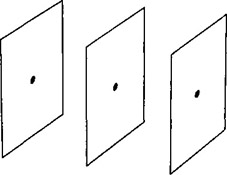
A third dimension is introduced when a succession of images is temporally sampled to represent motion. Figure 18.3 depicts samples in the same column and the same row in three successive frames.
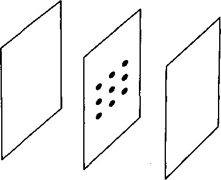
Complex filters can act on two axes simultaneously. Figure 18.4 illustrates spatial sampling. The properties of the entire set of samples are considered all at once, and cannot necessarily be separated into independent horizontal and vertical aspects.