Digital Video and HDTV Algorithms and Interfaces

This chapter introduces the basic features of the pixel array. I explain how the pixel array is digitized from the image plane, how pixel values are related to brightness and color, and why most imaging systems use pixel values that are nonlinearly related to light intensity.
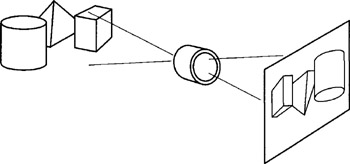
In human vision, the three-dimensional world is imaged by the lens of the eye onto the retina, which is populated with photoreceptor cells that respond to light having wavelengths ranging from about 400 nm to 700 nm. In video and in film, we build a camera having a lens and a photosensitive device, to mimic how the world is perceived by vision. Although the shape of the retina is roughly a section of a sphere, it is topologically two dimensional. In a camera, for practical reasons, we employ a flat image plane, sketched in Figure 1.1 below, instead of a section of a sphere. Image science concerns analyzing the continuous distribution of optical power that is incident on the image plane.