High Resolution Custom Microscope Objective Lenses
Featured Product from Avantier Inc.
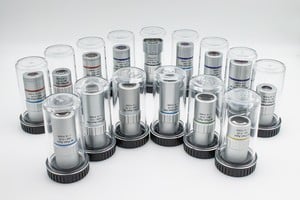
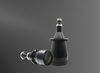
Microscope objectives are designed to magnify an object by a specific factor, ranging from 4x (a scanning objective) to 40x (a high-power objective), and even up to 100x for an oil immersion lens. To maximize flexibility, microscopes are often equipped with up to four objectives mounted on a rotating nosepiece or turret. In the case of an infinity-corrected objective lens, the magnification is calculated by dividing the reference focal length by the objective’s focal length.
Types of Objective Lenses
Based on aberration correction
- Achromatic objective lenses: Cost-effective lenses correcting chromatic aberration in two wavelengths and spherical aberration in one, suited for general microscopy.
- Plan Achromatic Objective Lenses add flat-field correction for uniform focus across the field of view, ideal where sharper, more consistent imaging is needed.
- Semi-apochromat lenses correct additional spherical aberrations and improve numerical aperture, delivering better resolution for more demanding applications.
- Apochromatic Lenses: The highest-performing tier, correcting the widest range of aberrations with maximum numerical aperture for exceptional resolution in precision research and color photomicrography.
Based on system
- Reflective Objective Lenses: Mirror-based design eliminating chromatic aberration, offering long working distances for FTIR spectroscopy and aberration-critical imaging.
- Refractive Objective Lenses: Traditional glass-element lenses using refraction for clear, sharp imaging, versatile enough for most standard microscopy applications.
Based on immersion medium
The choice of immersion medium between the objective lens and the specimen can dramatically affect the resolution and performance of the lens. Different media are used to improve light collection and enhance clarity.
- Oil-immersion Objective Lenses use a matched-index oil to achieve the highest numerical aperture and resolution, common in biological and high-precision research microscopy.
- Water immersion Objective Lenses offer higher resolution than air lenses, favored for observing living specimens in biological microscopy.
- Air immersion Objective Lenses: The most common type, offering good resolution but lower numerical aperture than immersion lenses.
- Glycerol immersion objective lenses balance oil and water immersion performance with a high refractive index, used in specialized techniques requiring improved light collection.
Custom Microscope Objectives at Avantier
Avantier continues to redefine precision microscopy with its cutting-edge NIR, NUV, and UV infinity corrected objectives. Engineered for accuracy and clarity, these objectives elevate research and analysis across near-infrared (NIR), near-ultraviolet (NUV), and ultraviolet (UV) spectra. With advanced optical coatings, aberration correction, and infinity-corrected designs, researchers can explore samples with unmatched clarity and fidelity. These objectives are pivotal for applications ranging from material science to life sciences, enabling scientists to delve deeper into the microscopic world with confidence. Avantier offers a wide variety of microscopes, each equipped with multiple objective lenses that can be rotated to view specimens at varying magnification powers. Demonstrating its commitment to excellence, Avantier delivers tools that empower scientific discovery and innovation.
Visit the Stock – Microscope Objectives page for in-stock microscope objective lens solutions. For custom solutions, don’t hesitate to contact us.
Related Content
Case Study: Small Objective Lenses in Medical Optical Systems
Case Study – 20X Objective Lens For Observing Blood
Objective Lenses: Designing and Assembling for Microscopes
Objective Lenses: A Guide to Aberration Correction
Optics for Aerospace and Defense