Guidelines for Choosing Stainless Steel
Featured Product from Eagle Stainless Tube & Fabrication, Inc.
Operating environment and performance
Corrosion resistance and heat resistance are the primary reason for specifying stainless steel. For these reasons, temperatures and chemicals are among issues to consider when determining the right grade for an application.304 and 316 alloys retain their strength, toughness, and corrosion-resistant properties in high temperatures.
Lower alloyed grades resist corrosion in atmospheric and pure water environments; high alloyed grades can resist corrosion in most acids, alkaline solutions and chlorine bearing environments making their properties useful in process plants. Chromium is the alloying element that imparts to stainless steels their corrosion resistance qualities by combining oxygen to form a thin invisible chromium-oxide protective film on the surface. The addition of molybdenum can increase the hardenability, toughness and tensile strength. The main reason to add molybdenum is to reduce pitting.
- Guidelines for Choosing Stainless Steel
Corrosion and heat resistance – the primary reason for specifying stainless steel. The specifier must know the environment and the degree of corrosion and heat resistance required.
Mechanical Properties – the mechanical properties of stainless steel determine the range of usefulness and life expectancy. For stainless steels the combination of corrosion resistance and strength would be the basis of selection.
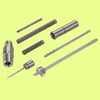
Fabrication Operations – Secondary operations can transform a simple tube into the part needed. CNC Machining, cutting, welding, bending and precision grinding are among the operations to tailor your tube to the part you need.
Total Cost – When the total life cycle costs are considered, stainless is often the best option. Maintenance-free material add to the cost saving benefit.
Type 304 stainless is the most commonly used stainless steel followed by type 316. Type 304 contains both chromium (between 18% and 20%) and nickel (between 8% and 10.5%)Type 316 contains chromium (between 16–18%), nickel (10–12%), and molybdenum (2–3%), with small (<1%) quantities of silicon, phosphorus & sulfur also present.
Purchasing a lab sample kit lets you experiment with sizes before running a production run. The kit features 90 pieces of 40” long hypodermic tubing in a full range of sizes from 6 gauge to 33 gauge – all with a variety of wall thicknesses. https://eagletube.com/products/lab-sample-kit/
DOWNLOAD OUR CATALOG
Your Primary Source for Stainless Steel Products
Download or request a hard copy of our updated design and manufacturing guidebook, offering valuable technical information to help you select the proper size and material composition for your unique needs. As a top stainless steel tube manufacturer we offer machining, welding, cutting, assemblies and bending while meeting or exceeding GMP and ASTM standards.
Watch>>Eagle Stainless Overview
For an overview of our fabrication services please see this pdf download.
Eagle Stainless Tube & Fabrication Inc.
Delivering Stainless steel, high nickel components to customers in the medical, aerospace and industrial industries.
- Distribution - Eagle ships products from inventory - tubing, bar stock, wire. Stocking both seamless and welded tubing.
- Precision cut-to-length - Eagles manufacuturing facility enables cutting and deburring up to 2" diameter and any quantity of hypodermic, fractional, metric and pipe sizes
- Customer Fabricated components - working to customer specifications and specializing in bending, CNC machining and EDM/ECG machining. Eagle can produce close tolerance parts for various industries.
ISO 9001
ISO 13485