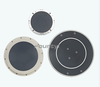
High-Precision Alumina Ceramic Guide Rails
Featured Product from Fountyl Technologies Pte. Ltd.

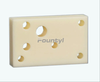
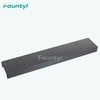
Modern multi-axis motion and automated transport systems dictate absolute positioning tolerances under volatile operating environments. This series of technical Alumina Ceramic Guide Rails provides an engineered material alternative to conventional metallic rails, delivering stable mechanical references through specialized microstructural constants:
Extreme Tribological Hardness: Exhibiting superior Vickers hardness compared to tool steels, these ceramic rails resist mechanical abrasion and progressive wear. This eliminates structural clearance growth over millions of operational motion cycles.
Sub-Micron Dimensional Stability: Characterized by a low coefficient of thermal expansion (CTE) and an exceptional elastic modulus, the alumina phase matrix limits thermomechanical deflection under fluctuating thermal gradients and heavy kinematic loads.
Ultra-Cleanroom Compatibility: Due to inherent material density and surface stability, these guide rails minimize operational particle generation, eliminating contamination risks inside high-vacuum cleanrooms.
Total Chemical Inertness: Sintered alumina resists aggressive fluorinated gases, wet chemical acids, and alkaline reagents, preventing chemical degradation, outgassing, or surface oxidation.
Target Applications and Process Environments
These technical ceramic components provide a rigid guiding baseline across high-end automated infrastructure layout configurations:
Semiconductor Fabrication Machinery: Wafer handling end-effectors, metrology stages, and automated track platforms requiring high repeatability.
Flat Panel Display (FPD) Production: High-speed material handling across LCD and OLED cleanroom assembly lines.
Photovoltaic and New Energy Systems: High-throughput silicon wafer transport, solar module positioning, and automated visual inspection platforms.
Precision Metrology and Robotics: Multi-axis coordinate measuring machines (CMM) and advanced robotics requiring low-inertia, high-rigidity linear motion.
Core Value and Operational Lifespan Benefits
Transitioning from metallic alternatives to precision-machined alumina guide rails yields clear operational benefits for equipment OEMs and fabs. By pairing sub-micron flatness and parallelism with extreme chemical resistance, this architectural layout drastically reduces maintenance intervals, eliminates the need for external lubrication, and extends the overall machinery lifecycle, lowering the total cost of ownership (TCO) in advanced smart manufacturing nodes.