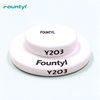
Spray-Dried Yttria Granulation Powder
Featured Product from Fountyl Technologies Pte. Ltd.
Yttrium oxide (Y?O?) is a cubic oxide ceramic with a melting point of 2430 °C, good electrical insulation, and optical transmission. In fluorine- and chlorine-based halogen plasma, yttria ceramics show low erosion rates and can reduce low-volatility fluoride deposition, particle generation, and metal-ion contamination. These properties make yttria suitable for semiconductor etch equipment and clean process environments.
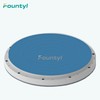
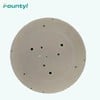
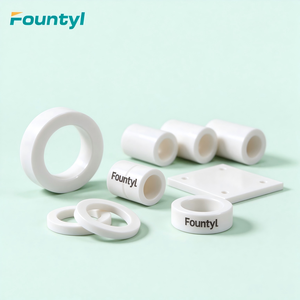
Fountyl supplies high-purity dense yttria ceramic components with forming, atmosphere sintering, precision grinding and polishing, precision cleaning, and clean packaging. Custom parts are available to drawing.
Representative sintered-body data from the supplied yttria material data sheet:
- Bulk density: 5.0 g/cm³.
- Flexural strength: 135 MPa; hardness: 746 HV.
- Coefficient of linear thermal expansion (RT-800 °C): 8.3 × 10??/°C.
- Thermal conductivity at room temperature: 14.88 W/(m·K); specific heat: 0.48 J/(g·K).
- Dielectric constant at 1 MHz: 11.8; dielectric loss at 1 MHz: 2.2 × 10??.
- Electrical resistivity: 1.5 × 10¹? Ω·cm.
- Low erosion rate in fluorine-containing plasma can reduce chamber contamination and particle generation.
- High-purity, dense ceramic with low open porosity limits the risk of bulk flaking in clean process environments.
- The material is stable in many acids, bases, and high-temperature chemical media.
- A melting point of approximately 2430 °C supports structural stability in high-temperature service.
- Good electrical insulation supports high-temperature insulating and support components.
- Etch chamber liners, focus rings, and insulating rings.
- Gas distribution and gas-flow guide components.
- Wafer support platforms, support bases, and locating parts.
- High-temperature insulating structural parts.
- High-purity crucibles, boats, and other high-temperature containers.
- Plasma protection substrates and corrosion-resistant structural components.
- Grinding, polishing, drilling, and slotting are supported.
- Flatness, parallelism, dimensional tolerances, and surface condition can be specified to drawing.
- Selection should consider plasma chemistry, operating temperature, mechanical load, cleanliness, and component life.
- Because yttria is a higher-cost material with challenging machining, wall thickness, geometry, and machining allowance should be reviewed for the actual process.
The process covers ceramic forming, atmosphere sintering, precision grinding, polishing, cleaning, and clean packaging. Complex rings, tubes, plates, gas-channel parts, and locating structures can be produced to drawing.