Brewer’s Spent Grain Dewatering
Featured Product from KINTEP NEW POWER
Introduction
Brewer’s spent grain (BSG) is the largest byproduct of beer production, accounting for approximately 85% of total brewing residues. With global annual output reaching 39 million metric tons, this fibrous material—composed of husks, seed coats, and undissolved starch particles—holds significant potential for animal feed, organic fertilizer, and biogas generation. However, its inherent high moisture content (typically 75–80%) poses critical challenges for downstream utilization. This article explores how advanced screw press dewatering technology addresses these hurdles, enabling consistent, cost-effective BSG valorization.
The Core Challenge: Moisture Control for Resource Efficiency
BSG’s native moisture level of ~80% makes it unsuitable for direct applications:
• Composting & fermentation require an optimal moisture range of 60–65%. Above 65%, the material turns anaerobic, emitting foul odors and prolonging degradation; below 60%, protein structures are damaged, reducing feed and fertilizer quality.
• Animal feed with >65% moisture spoils rapidly due to mold and acidification, limiting transport distance and forcing local, low-margin sales.
• Storage & handling demand vast drying areas, while airborne odors create environmental compliance pressures.
Traditional methods like sun-drying or adding bulking agents (wood chips, straw) are inefficient, costly, and unreliable—especially under variable weather or high-throughput production.
The Screw Press Solution: Precision Dewatering
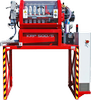
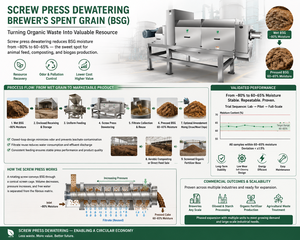
A screw press operates on a simple yet robust principle: a rotating screw conveys material through a conical screen cage, progressively increasing pressure as the volume decreases. This mechanical action separates free water from the fibrous matrix, delivering pressed dry cakes with adjustable final moisture.
For BSG, the key performance target is stable dewatering from 80% to 60–65% moisture—the sweet spot that preserves nutritive value while enabling stable composting, pelleting, or anaerobic digestion.
Process Integration: From Wet Grain to Marketable Product
A fully engineered system typically follows this sequence:
80% wet BSG → Enclosed receiving/storage → Uniform feeding → Screw press dewatering → Filtrate collection/reuse → Pressed BSG (60–65%) → Optional amendment mixing (straw/wood chips) → Aerobic composting or direct feed sale → Screened organic fertilizer base
Results: All output samples fell within 60–65% moisture, with deviation < ±1.5%, demonstrating exceptional repeatability.