Custom Mixing and Blending Controllers
Featured Product from Sterling Systems & Controls
Mixing can be a key part of the production process, in many industries. Where Batching is found you will find mixing and blending. Sterling Systems & Controls, Inc. CUSTOM designs and supplies mixing control systems to fit specific customer need.
One such mixing system is found in rubber compounding. Let's highlight this here. The first step in most plastic fabrication processes is compounding. This is the mixing together of various raw materials in a specific proportion in order to produce a specific material, generically referred to as a compound. Most often to produce a rubber compound a combination of plastic resin (pellets, flakes, powders, or liquid) is combined with other materials, including liquids and bulk solid materials. The combining of the solids and liquid together requires mixing.
Sterling Systems & Controls, Inc. has designed and supplied a customized batching system for a rubber compounding application, providing a variety of mechanical equipment, such as a bulk bag unloading system, electrical controls and automation. In this application the automation control system includes a PanelView+ touchscreen HMI with a customized RSView ME software application. As a part of the automation system the ingredients are mixed. Because there are both liquid and solid ingredients a specialty mixer is used.
The workhorse mixer of the plastics and rubber industries is the internal mixer, in which heat and pressure are applied simultaneously. The internal mixer uses two interrupted spiral rotors moving in opposite directions at a set RPM as required by the compounding process for the rubber compound being produced. The shearing action in the internal mixer is intense, and the power required for operation can be quite high.
Custom Mixer process control is required to produce the end product and automate for optimal efficiency. This is a part of the overall automation and process control system provided by Sterling Systems & Controls, which included:
- Main batching process
- Mixer process
- Auxiliary batching
- Drop mill process
- Extruding
- Cooling
Mixer Control
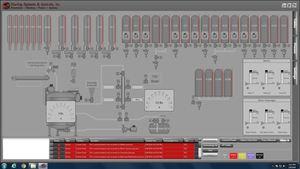
The HMI Mixer screen (shown below) is an extension of the Main Batching screen showing all of the equipment associated with the Mixer. From the Mixer screen, the user has the capability to control the mixer’s RPM on the running formula like on the Main Batching Process screen, but with the additional capability to view the status of and control the related equipment shown on the left side of the Mixer screen. This screen also offers a data trending screen that allows the user to view the Batch Temp, Mixer Torque, Mixer Power, and Mixer Speed for the last twenty hours.