
Fiber Optic Wire and Cable Crimpers
Description
Fiber optic wire and cable crimpers are specialized tools used to join fiber optic cables with connectors by deforming one or both of them to hold each other. This process ensures a secure and reliable connection necessary for the transmission of data through fiber optic cables.
Working Principle
Fiber optic crimpers work by applying pressure to a connector and the fiber optic cable, creating a mechanical bond between them. This bond is achieved by deforming the connector around the cable, ensuring that the connection is both secure and capable of transmitting data effectively. The crimping process is crucial because it provides strain relief, which helps maintain the integrity of the connection over time. This is particularly important in fiber optics, where precise alignment and secure connections are essential for optimal data transmission.
Applications
Fiber optic crimpers are used in various applications where fiber optic cables are employed. Specific examples include telecommunications, where they are used to connect cables in network installations, and in data centers, where they help establish connections between servers and networking equipment. Additionally, they are used in the aerospace industry for connecting fiber optic cables in aircraft systems, and in medical equipment where precise data transmission is critical.
Advantages over other Wire and Cable Crimpers
Fiber optic crimpers offer advantages over traditional wire and cable crimpers due to their ability to handle the unique properties of fiber optic cables. Unlike metal wires, fiber optic cables are made of glass or plastic, requiring specialized tools to avoid damage during the crimping process. Fiber optic crimpers are designed to provide the necessary precision and care needed to maintain the integrity of the delicate fibers, ensuring high-quality data transmission.
Limitations
One of the main limitations of fiber optic crimpers is their specificity; they are designed to work with fiber optic cables and may not be suitable for other types of cables. Additionally, the crimping process requires precision and care, as improper crimping can lead to data transmission issues or damage to the fiber optic cable. The fragility of fiber optic cables also means that crimpers must be used by trained professionals to avoid breakage.
Considerations
When selecting fiber optic crimpers, several factors should be considered. Initial costs can be higher than those for traditional crimpers due to the specialized nature of the tool. Operating expenses may also be higher, as the tools require regular maintenance to ensure precision and accuracy. Durability is a key consideration, as high-quality crimpers are necessary to withstand repeated use without degrading performance. Accuracy is critical, as even minor misalignments can affect data transmission. Replacement and maintenance costs should also be factored in, as worn or damaged crimpers can compromise the quality of the connections they create.
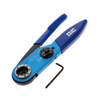
from DigiKey
TOOL HAND CRIMPER SIDE [See More]
- Application / Connector Type: Fiber Optic; Fiber Optic Contacts
- Form Factor: Handheld
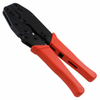
from DigiKey
Hand Crimper Tool Coaxial, RF and Fiber Optics - SMA, SMB [See More]
- Application / Connector Type: Coaxial; RF Connector; Fiber Optic; Coaxial, RF and Fiber Optics - SMA, SMB
- Form Factor: Handheld
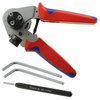
from DigiKey
Hand Crimper Tool Fiber Optic Contacts [See More]
- Application / Connector Type: Fiber Optic; Fiber Optic Contacts
- Form Factor: Handheld
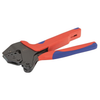
from DigiKey
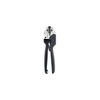
Hand Crimper Tool Fiber Optic Connectors [See More]
- Application / Connector Type: Fiber Optic; Fiber Optic Connectors
- Form Factor: Handheld
from DigiKey
Hand Crimper Tool Fiber Optic Connectors [See More]
- Application / Connector Type: Fiber Optic; Fiber Optic Connectors
- Form Factor: Handheld
from Broadcom Inc.
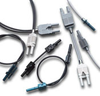
Four connector styles are available for termination of plastic optical fiber: simplex, simplex latching, duplex and duplex latching. All connectors provide a snap-in action when mated to Versatile Link components. Simplex connectors are color coded to facilitate identification of transmitter and... [See More]
- Application / Connector Type: Fiber Optic; Compatible with Avago Versatile Link Family of Connectors and Fiber Optic Components
- Form Factor: Handheld
- Power: Hand Tools

from PHOENIX CONTACT USA
Crimping pliers, for fiber optics connectors, 3.25 mm, 3.84 mm, 5.41 mm, 5.00 mm, 4.52 mm, HEX crimp [See More]
- Application / Connector Type: Fiber Optic
- Form Factor: Handheld
- Power: Hand Tools

from Fiber Instrument Sales, Inc./FIS
FIS Crimp Tool (Die & Handle) [See More]
- Application / Connector Type: Fiber Optic
- Form Factor: Handheld
- Power: Hand Tools

from Fluke
Make effortless, uniform connections with Fluke Networks ’ D814 ™, all-in-one, telecom punchdown tool. Its adjustable impact wheel has high and low settings for any type of termination. Automatic spring mechanism provides right impact to seat and/or terminate wires. Compartment at the... [See More]
- Application / Connector Type: AdvancedTCA; Fiber Optic; Network/Cabling
- Form Factor: Handheld
- Power: Electrical; Hand Tools

from L-com, Inc.
The L-com FOT-CT-STFCSC is a Fiber Optic Crimp Tool, which includes the die and handle. It is designed for the crimping of ST, FC, and SC connectors. The L-com FOT-CT-STFCSC has 4 crimp sizes: .128 inches, .137 inches, .151 inches, and .190 inches. The L-com FOT-CT-STFCSC is just one of thousands of... [See More]
- Application / Connector Type: Fiber Optic

from Fluke
The D914 ™ Series impact tools provide quality terminations on the first punch, helping to achieve the highest quality possible on network installations. They are the only impact tools that combine torque and impact in one tool. They also include a built-in hook and spudger into the handle. [See More]
- Application / Connector Type: AdvancedTCA; Fiber Optic; Network/Cabling
- Form Factor: Handheld
- Power: Electrical; Hand Tools