
DC Voltage Application Valve Positioners
Description
DC Voltage Application Valve Positioners are devices used to control the position of a valve by adjusting the input signal, which is typically a DC voltage. These positioners ensure that the valve reaches and maintains the desired position, allowing for precise control over fluid flow within a system.
Working Principle
DC Voltage Application Valve Positioners operate by receiving a DC voltage signal that corresponds to a specific valve position. The positioner translates this signal into a mechanical movement, adjusting the valve to the desired position. This process is often managed through a closed-loop control system, which continuously monitors the valve position and makes necessary adjustments to maintain accuracy. The use of DC voltage allows for precise control and feedback, making these positioners particularly useful in applications requiring high precision and reliability.
Applications
DC Voltage Application Valve Positioners are commonly used in industries where precise control of fluid flow is critical. For example, they are utilized in chemical processing plants to regulate the flow of reactants, ensuring optimal reaction conditions. They are also employed in water treatment facilities to control the flow of water through various treatment stages, maintaining the quality and efficiency of the process.
Advantages over other Valve Positioners
One of the primary advantages of DC Voltage Application Valve Positioners is their ability to provide precise control and feedback, which is essential for applications requiring high accuracy. Unlike traditional analog positioners, digital positioners using DC voltage can achieve greater precision and require less energy to operate. For instance, digital positioners can reduce the consumption of compressed gas by up to 90% compared to analog counterparts, as noted in the Siemens SIPART PS2 positioner example .
Limitations
A limitation of DC Voltage Application Valve Positioners is their dependency on a stable power supply. Any fluctuations in the DC voltage can affect the accuracy and reliability of the valve positioning. Additionally, these positioners may require more complex installation and calibration processes compared to simpler mechanical positioners.
Considerations
When considering the use of DC Voltage Application Valve Positioners, it is important to evaluate the initial costs, which may be higher due to the need for advanced control systems and precise calibration. Operating expenses can be lower due to reduced energy consumption, particularly in digital models. Durability and accuracy are generally high, but regular maintenance and calibration are necessary to ensure long-term performance. Replacement and maintenance costs should also be factored into the overall cost of ownership, as these can vary depending on the complexity of the system and the specific application requirements.

from Rotork plc
Low power - under 2.0W (24 Vdc) Essential component in the control and testing of pneumatic, hydraulic and electro-hydraulic valve actuators Provides a unique partial stroke test solution suitable for SIL applications Available with Ex i intrinsically safe 4-20mA command and retransmission signals... [See More]
- Electric Actuation Type: DC Voltage Application
- Pneumatic Actuation: Single Acting Positioner; Double Acting Positioner
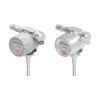
from Rotork plc
ow power - under 2.0W (24 Vdc) Essential component in the modulating control of pneumatic, hydraulic and electro-hydraulic valve actuators Provides an accurate and flexible positioning system 4-20mA isolated command and retransmission signals Integral linear, current or potentiometer valve feedback... [See More]
- Electric Actuation Type: DC Voltage Application
- Pneumatic Actuation: Single Acting Positioner; Double Acting Positioner
- Valve Actuation: Linear

from Exlar
The SV Series Positioners were designed specifically for use with Exlar rotary and linear actuators to control valves and dampers in process control applications. The all-electric design eliminates the complexity of applying electro-hydraulic interface pilot valves or electric-pneumatic positioners,... [See More]
- Electric Actuation Type: Single Phase AC Application; Three Phase AC Application; DC Voltage Application
- Valve Actuation: Linear; Rotary
- Positioner Type: Digital; Electronic
- Milliampere Input Signal Range: 4 to 20